What an Old Stopwatch Taught Me About Learning
How everyday objects can become simple learning games that build focus, memory, reaction time and curiosity.
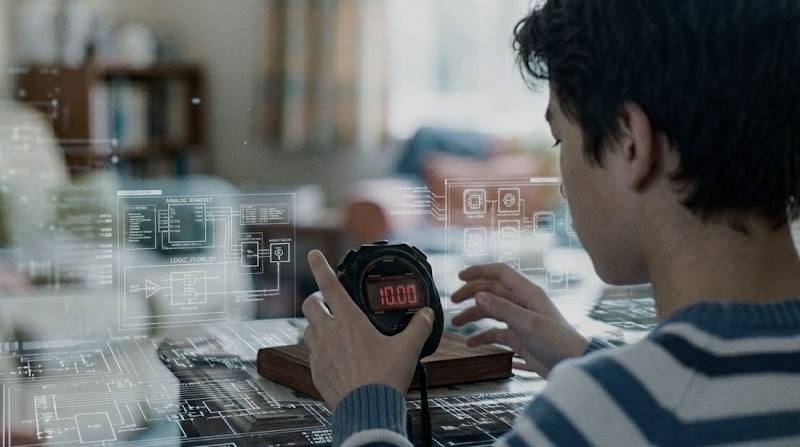
When I was a child, one of my friends had a simple digital watch. Nothing special. It wasn't a toy, a game console, or a fancy gadget.
But it had a stopwatch.
One day, we invented a game: stop the timer at exactly 10.00 seconds.
It sounded easy.
It wasn't.
The first attempt landed at 9.74. The next one at 10.31. Then 9.89. The closer we got to perfection, the more interesting the challenge became. Before we knew it, we were standing around a simple watch for long stretches of time, trying to improve by just a fraction of a second.
Looking back, what surprises me isn't how much fun we had.
What surprises me is that nobody taught us the game.
No adult planned the activity. No app guided us through it. We simply took an everyday object and turned it into a challenge.
And it made me wonder:
How many games are hiding around us right now?
The Best Games Don't Always Look Like Games
When we hear the word "game," we often think of smartphones, tablets, computers, or colorful toys bought from a store.
But children don't necessarily need a new toy to play.
They need a challenge.
In fact, almost any everyday object can become a game when you add a goal, a simple rule, and a little curiosity.
The stopwatch was just one example.
A Timer That Teaches Focus
Today, almost every phone, microwave, and oven has a timer.
Ask a child to close their eyes and raise their hand when they think exactly one minute has passed.
Suddenly, a simple task becomes a challenge.
Who was closest?
Who missed by only two seconds?
Without realizing it, children are practicing focus, time awareness, patience, and self-control.
Turning the Living Room Into a Measurement Lab
One day I asked a child how many steps it would take to walk from the couch to the refrigerator.
They guessed.
Then we tested it.
They were off by almost double.
But on the second try, they were much closer.
That's how estimation skills develop—not through worksheets, but through curiosity, experimentation, and immediate feedback.
The same idea works with kitchen scales, rulers, measuring cups, and countless other objects already sitting around the house.
Games That Train the Body and the Brain
Not all learning has to happen sitting still.
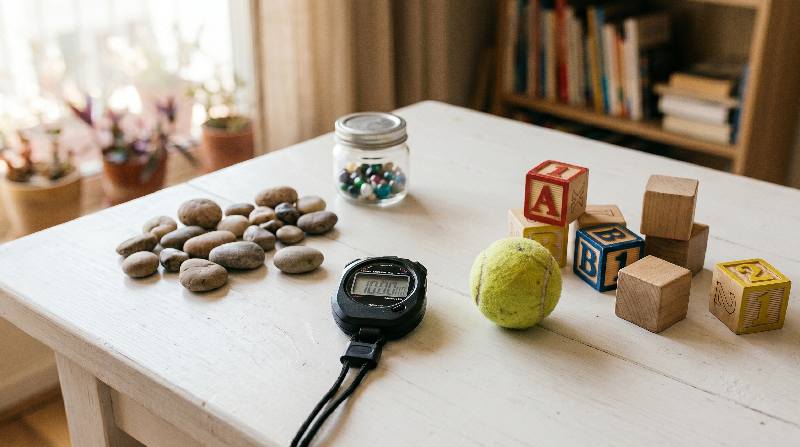
Sometimes all you need is a small ball.
Drop it without warning and challenge someone to catch it before it hits the floor.
That's it.
No scoreboard. No screen. No complicated rules.
Yet the game instantly trains reaction time, hand-eye coordination, focus, and many of the same skills developed through modern reaction games.
The same is true for simple challenges like catching a coin in midair or testing your reflexes with everyday objects.
Memory Hides in the Small Details
One of my favorite games is also one of the simplest.
Ask a child to look at you for ten seconds.
Then ask questions:
What color were my socks?
Was I wearing a watch?
Were my sleeves rolled up?
Most children quickly discover they noticed far less than they thought.
And that's exactly the point.
The game transforms attention to detail into an interesting challenge instead of a task.
In many ways, it's a simple memory game hiding in plain sight.
Why Do These Games Work So Well?
Because they don't feel like learning.
When children receive a worksheet, they know they're supposed to learn.
When they're trying to stop a timer at exactly 10 seconds or remember what was sitting on the kitchen counter, they're simply trying to succeed.
The learning happens along the way.
No pressure.
No grades.
No convincing required.
Years later, I found myself applying the same idea when designing educational games and reaction games. The goal wasn't to make learning feel like work, but to create challenges that naturally encourage focus, timing, hand-eye coordination, and repeated practice. That same philosophy eventually inspired Speed Tap, where improvement comes from trying again rather than being told to learn.
Final Thoughts
Today we're surrounded by technology, apps, and sophisticated games.
Yet I often think back to that simple digital watch from my childhood.
It wasn't smart.
It didn't have animations.
It didn't offer rewards or achievements.
And yet it kept us focused, motivated, competitive, and eager to try again.
Maybe that's the most important lesson for parents and teachers:
Not every great game starts in an app store.
Sometimes it starts with a microwave timer, a small ball, or a simple question that sparks curiosity.
Because in the end, technology isn't what drives learning.
Challenge is.